Last summer, Tim delivered a two-part online sermon on the Seven Deadly UX Sins plaguing the Fediverse: first the diagnosis, then the path to redemption. Sean wrote his own set of solutions. It was the kind of tough love we felt the Open Social Web desperately needed: unflinching about problems, genuinely hopeful about fixes.
It kicked off a lot of great and constructive discussions.
But redemption requires actual work. Good words alone aren’t enough.
So we decided to play professor every 6 months or so, and grade these redemption efforts; not on vibes, not on good intentions, but on what’s actually shipped since then. And what is about to. The goal is not to be a wagging finger, but to applaud and focus attention on good work. And maybe incite donations and volunteering to move other things faster.
Between Tim’s years running Indieweb.social and Sean’s decade-plus chronicling the distributed web at We Distribute, we’ve watched these problems persist longer than we’d like to admit.
The grading scale:
- A: Shipped and working. Users benefiting right now.
- B: Solid progress. Real commits, real momentum, shipping soon.
- C: Good ideas on paper. Some movement, waiting on execution.
- D: Acknowledged problem. Minimal progress.
- F: Crickets. Or actively getting worse.
If we missed anything, reach out and we’ll update this. Let’s dig in.
Reflections
The List of Sins
As with our previous analysis efforts, we’ve split everything up into sections to make it easier to read, navigate, and parse. These are long-standing issues both Tim and Sean have seen in the Fediverse, with reflections on how things may or may not have changed in the past six months.
Sin 1: Instance Selection Paralysis
Redemption: One Single Social Home to Join, Many Doors Later

The Problem
New users arrive ready to escape Big Tech, and we immediately hit them with 8,000 servers named like medieval taverns crossed with startup pitches. Half bail before creating an account. Why does this happen? Our best reasoning suggests that initially joining an instance feels like a big commitment, and people often have to do this while knowing very little about the community they’re getting into.
Our Suggested Fix
The problem is akin to walking into a restaurant with a really, really big menu. You may have had some idea of what you initially wanted, but as you thumb through the different choices, you start to realize you actually are less certain about what to get. Choice is good, but this is overwhelming.
Here’s the thing: keep the offering of choices simple for people just starting out, and offer a single no-brainer choice to get the ball rolling. If centralization is a concern, it’s possible to offer a curated round-robin of trustworthy servers, preventing any individual instance from being overloaded. While everybody wants some level of choice, they also want a reduction in friction. This is one way to do both.
What’s Happened Recently
Mastodon’s mobile apps have long defaulted to mastodon.social with an optional “choose another server” toggle—exactly where it should be. As they stated in their February 2026 blog post: “As people fled from traditional social media in late 2022, we made a strategic decision to send new sign-ups directly to mastodon.social. This choice was driven by our desire to reduce cognitive load for new users and ensure a stable onboarding experience.” That was the right instinct.
New fediverse apps focused on individual communities like the Toot Wales app, completely streamline this purely into their server. This is part of Newsmast’s overall strategy of empowering news and other local communities, and creating dedicated apps and servers specific for each, with specific onboarding for each community.
 Image courtesy of Newsmast Foundation
But recently, the Mastodon team has also recognized the problem and added this: “Right now, too many newcomers default to the largest servers. We want to change that—because Mastodon is best when communities are spread across many independent servers.” They’re actively working on a new mobile flow that points users to other servers. That is very close to our round-robin suggestion. Maybe better, as it does some performance checks for best servers near you.
On web: Mastodon 4.4 shrunk web onboarding from four steps to two—real progress, even if incomplete.
Other platforms are also leading:
- PieFed shipped an instance chooser very close to our suggestion. It includes a big simple way to join the flagship but also with a “help me choose” button for those who want to go deeper. And like Mastodon: a sophisticated instance chooser that sorts by lots of easy-to-grasp criteria for those who want to dig into it.
- Loops sends users directly to their main server via JoinLoops.org. Simple, direct. (No round-robin, but we applaud the simplicity as a first start.)
- Holos takes a radical approach: running a complete ActivityPub server on your phone (from the developer of Fedilab). No server choice because your phone IS your server. The relay provides a stable identity, but onboarding is zero-friction because the concept simply doesn’t exist. See how it works and the FAQ. It’s early-days, but fascinating proof that “pick a server” can be eliminated entirely.
What’s Still Broken
Web onboarding across most of the Fediverse: PixelFed, PeerTube, Misskey, etc., all still ask users to solve a puzzle before joining. At the very least, JoinMastodon.org has improved to a “two choices” flow, but we look forward to seeing this exact same mobile UX being applied to Web. It’s in the works.
For most platforms, it’s more hazing ritual than clean onboarding. And other than the planned effort underway at Mastodon (which at first will be mobile only), none of the others have tried the more simple round-robin idea yet. There no doubt would be some complexity in setting this up, but It’s just waiting there for folks to try.
Sean proposed something more ambitious: identity-first onboarding, where you import your social graph and content before choosing a server. The idea: set up a “pre-identity” that pulls in your posts and connections from other networks, then pick a server that fits. Tools like Bounce from A New Social are experimenting in this direction. It’s still aspirational, but points toward a future where “pick a server” isn’t the first question new users face.
Final Grade
Grade: B-
Mastodon, PieFed, Loops, and Holos earn serious credit for shipping (or about to ship) big parts of what we suggested. PieFed’s instance chooser is particularly noteworthy, but could be integrated on. Now the rest need to follow.
Sin 2: Timeline Turmoil
Redemption: One Feed To Rule Them All (at First)
 “Relativity” by MC Escher
The Problem
Mastodon and a lot of other Fediverse platforms offer three different timelines for representing social activities: Home, Local, and Federated. Each more metaphysically confusing than the last. “Home” at least makes sense, because it’s everyone you’re following. “Local” sounds cozy, but is actually your server’s collective brain dump. “Federated” is the cosmic firehose of everything, everywhere, in languages you don’t speak.
 Kind of like what happened after the Tower of Babel
What people want is to be able to easily cut through all the noise and connect with people on the subjects that they care about the most. It’s not so much that we want a bunch of different timelines, but a way to dig into one timeline in a bunch of different ways.
Our Suggested Fix
Cut the interface down to one feed, with some tools to bring desired behavior to the forefront. Use progressive disclosure to introduce others as “power-ups,” not puzzles. “Want to see what’s trending nearby?” “Curious about the wider Fediverse?” Let them level up like a video game character.
What’s Happened
Mastodon web has since hidden the extra feeds by default, to their credit. They also did this in Mastodon 4.5:
Feed Toggles: Admins can now selectively disable specific content feeds (like the Federated Timeline or Trending) for both logged-in users and unauthenticated visitors. Good: enables admins to choose simplicity.
Loops launched something especially interesting: They present both a “Following” feed (chronological, people you trust) and a “For You” feed (algorithmic discovery). The key distinction from TikTok: “For You” is powered by engagement and social graph signals, not ads or dark patterns. As they put it: “A calm chronological Following feed for the people you trust—and a For You feed that surfaces new creators. No dark-pattern growth hacks.”
(Minor nitpick: we’d suggest they move “Local” feed back under “Explore” and make it only “Following” and “For You.” But we digress.)
What’s Still Broken
No platform implements the true progressive disclosure idea yet. Multi-timeline confusion remains the default on PeerTube, Misskey, and others.
As Sean put it: “We don’t need more timelines, we need better ones.” Projects like FediAlgo and Channel.org are experimenting with custom feeds and algorithmic filtering, following Bluesky’s lead. The goal isn’t to replicate TikTok’s dopamine machine, but to give users powerful ways to sort and filter their Home timeline without needing to understand federation theory. Sean has been following the ActivityPub Client to Server API developments, with a few clients beginning to experiment with that – notably Ghost and WordPress Reader apps – and we think there may be room for innovating on unified feed UX there.
Final Grade
Grade: B+
Kudos to Mastodon for giving each admin the ability to choose to bury the feeds that never made sense to each individual server community. Loops gets credit for the right framing. Closest to fully solved. The biggest thing now is to focus on intuitive ways that users can filter and curate their own timeline experiences. When more critical mass of platforms actually hide extra timelines until users ask, we’re looking at an A.
Sin 3: Remote Interaction Purgatory
Redemption: Protocol Handlers and JavaScript Salvation
 Source: The Flammarion Engraving
The Problem
Following someone on a different instance involves copy-paste gymnastics, cryptic search boxes, and prayers to the federation spirits. Every extra step cuts user retention in half. Why do we have to do this manually in 2026? The awkward truth is that many long-term Fediverse users have simply gotten used to it, but there are definitely better ways to handle the UX shortcomings.
Our Suggested Fix
Browser protocol handlers (like mailto:) to let users set their home server once. For browsers without support, a lightweight JavaScript fallback.
What’s Happened
This one’s complicated. Again: non-issue on mobile apps, but a problem from day one on web.
As we noted last summer: Native apps like Ivory, Mona, and Ice Cubes sidestep this entirely—great for their users, doesn’t help the open web.
Desktop browser support for protocol handlers has now grown to ~90%. We could ship something that works for most desktop users today, with JavaScript covering the rest. Tim gave some sample code here. But mobile browsers still don’t support protocol handlers at all—and mobile is now the majority of web traffic.
The FediDev community has debated protocol strings for years. “web+ap! fedi+ap! activity+whatever!” But that debate may be settling: mobile apps are adopting web+ap. Fedilab shipped web+ap support (confirmed April 2026), Holos Discover is implementing it, and Tusky has an open issue to add support. This creates a path where Android users can tap a web+ap: link and have it open directly in their Fediverse app—bypassing the browser entirely.
On a semi-adjacent front: A new tech named “Activity Intents” is starting to gain adoption. It doesn’t solve this UX sin now, but might in the future. For today: think of it as a standardized “follow this account” or “like this post” button that any website can use, like the old Facebook buttons embedded across the web. Tomorrow it might help with this exact Remote Interaction Sin.
 Activity Intents are kind of like the Android Intents system, but specifically for individual social interactions on remote sites.
Activity Intents (FEP-3b86) merged into Mastodon in March 2026. Emissary has it. PieFed and Loops support it now too. As does WordPress’s ActivityPub plugin. Watch this space.
Sean also highlighted Hubzilla’s MagicAuth, which is a cookie-based approach that lets you interact with remote servers as if you’re logged in. It’s been around for years but never gained cross-platform adoption. The concept is sound: your browser carries credentials that remote servers can verify, letting you like, follow, and reply without the copy-paste dance. If ActivityPub platforms adopted something similar, this sin could be fully redeemed.
But we saved the most interesting thing here for next:
Here is a promising idea of a new approach from Mastodon’s CTO that began to be implemented in Mastodon 4.6 and will evolve in future versions: where in the not-distant future, the fediverse server you post on would tag URLs pointing to ActivityPub objects, letting other web apps see that “cheat sheet” note, and automagically letting native fediverse apps open content directly without copy-paste.
To our view this feels like the ultimate answer to a large portion of – but admittedly not all – of this problem; but that shouldn’t delay getting the partial fixes out the door while we await that. We feel the above fixes – Protocol Handlers, Javascript backups, and Object Tagging working in combo have the potential to strip away 90% of the UX pain that users currently face 100% of the time. We don’t need to solve the ‘web architecture’ problem to solve the ‘user frustration’ problem.”
What’s Still Broken
There’s a lot of great ideas, and some early motions in the right direction. Unfortunately, the Web experience largely remains copy-paste purgatory. Users don’t see fantastic underlying infrastructure in place to deal with future problems, they see the friction they’re experiencing here and now.
Final Grade
Grade: D-
The roadmap exists. The browser support exists for desktop. Mobile apps are finally adopting web+ap. But the user-facing Web experience hasn’t improved. We’re not bumping the grade for plumbing users can’t see yet, but hope to by the next report.
Sin 4: DM Disasters Waiting to Happen
Redemption: Direct Messages That Aren’t a Death Trap
 “Hey, you accidentally mentioned the guy you’re gossiping about in that private message. He read everything.”
The Problem
Private messages in most Fediverse apps are what can be described as a “foot gun”, that is, something to shoot yourself in the foot with unintentionally. Private messages live in the same composer as public posts. One wrong toggle separates “venting to a friend” from “broadcasting to the Fediverse.” Plus, as of today, no encryption—DMs are plaintext dressed as secrets.
Our Suggested Fix
The main headache here is that direct messaging appears to be a separate, distinct interface designed to mimic email or DMs, but it’s really just a post authoring system pretending to be a messaging pane. There’s also some legitimate UX confusion between what a “Private Message” is supposed to be, as opposed to what a “Private Status” is supposed to be. That’s because they’re the same thing, being used in two different ways.
What we need to do is break direct messages out of the status authoring flow, and give it a different interface with distinct behavioral cues. Confirmation modals explaining when someone not in the recipients field is being mentioned might be a good temporary workaround. Visual indicators that these messages aren’t encrypted are a good idea, too.
Sean’s offers a simpler framing: stop calling them “Private Mentions” and build real DMs, where addressing happens outside the post body.
What’s Happened
This is the redemption success story.
Phanpy shipped nearly everything we asked for: separate composer, dramatically different visual styling, private messages in their own tab. It now has an iOS app (iPhanpy) and remains one of the most thoughtfully designed clients. See the source code. Help it and iterate on it.
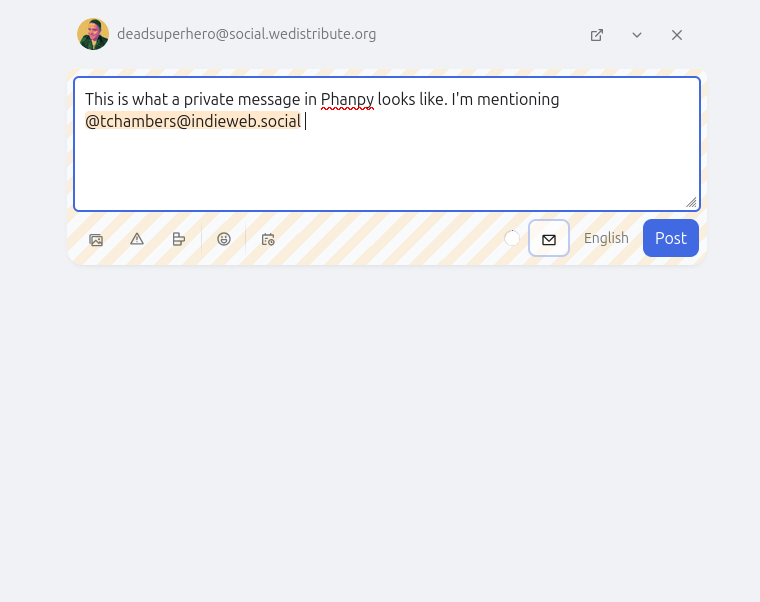

Newsmast previews show similar design philosophy. Which will power a whole suite of new open source apps.
The core UI for so much of the rest of the Fediverse? Still hasn’t caught up. (At least so far.) You can still accidentally blast a private thought to the world with one wrong toggle. But at least the path is proven. Phanpy did the homework. Everyone else can copy it.
What’s Still Broken
Many clients use the risky unified composer. UX still often implies direct messages are in some way private although they in every way are not encrypted.
Adjacent Big News: Mastodon announced Sovereign Tech Agency funding for E2EE direct messages. Work begins late 2026, with implementation targeted for Q2 2027. They’ll coordinate with the Social Web Foundation’s E2EE project and implement ActivityPub E2EE extensions once the W3C delivers a specification. Real encrypted DMs are finally on the roadmap. And in a first: Holos has E2EE using Signal Protocol for Holos-to-Holos DMs.
Final Grade
Grade: B+
Phanpy gets an A. The ecosystem gets a C. Averaging to B+ because the solution exists and is shipping in a number of key places—it just hasn’t propagated everywhere. This is how redemption should work: one app leads, others follow. Now we need the following to happen.
Sin 5: Ghost Conversations and Phantom Followers
Redemption: Filling in the Blanks

The Problem
Federation means you only see what your server has fetched. Replies go missing. Threads arrive with limbs amputated. Follower counts are carnival mirrors—someone shows “800 followers” on their server, you see 12 on yours.
Our Suggested Fix
Auto-fetch surrounding context when users open posts. Show a “fetching…” indicator.
What’s Happened
Ghost Conversations: Done. Shipped. Users benefiting. HOORAY!
Mastodon 4.5 (November 2025) includes automatic reply backfilling: “Users on servers running 4.4 and earlier have likely experienced the confusion of seeing replies appearing on other servers but not their own. Mastodon 4.5 automatically checks for missing replies upon page load and again every 15 minutes, enhancing continuity of conversations across the Fediverse.”
Other platforms have been working on this too—NodeBB reports that backfill from Mastodon instances is “working really well” as more instances upgrade.
Credit where due: the initial Mastodon contribution for this came from Jonny (@jonny@neuromatch.social), a new Ruby coder who pushed through anyway. Then the Mastodon team jumped in to review and further implement. That’s how open source should work. That is exactly the sort of developer contributions we hope these reports help incite on various fediverse development efforts.
What’s Still Broken
Phantom follower counts remain an unchanged set of carnival mirrors. The new backfill fixes missing conversations, not missing follower graphs. Your server still only knows about followers it has seen, so remote accounts show wildly inaccurate counts. No fix shipped yet.
Special note: Mastodon’s CTO and Tim had some interesting chats over how this might be fixed in the future. In essence, this strategy for ghost followers proposes that servers should fetch remote profile data on-demand only for the specific followers a user is currently browsing, then automatically purge that data from the local database unless the user explicitly chooses to follow those accounts. This would provide the “missing” visibility of followers, that users crave while avoiding the needless database bloat of storing thousands of accounts that the user never intends to follow.
Final Grade
Grade: A-
This is what redemption looks like for ghost conversations. A real problem, identified. Code written and merged. Feature shipped. Users benefiting. A- instead of A because phantom followers remain broken, this needs to branch out beyond Mastodon, and some edge cases remain.
Sin 6 (Part 1): Search Without Surveillance
Redemption: Discovery That Respects Privacy
 “Jephthah’s Daughter Coming to Meet Her Father”, Gustave Dore
The Problem
Search is opt-in, buried in settings. At FediForum 2024, Mastodon CTO Renaud Chaput confirmed only 8-10% of users have opted in—not because they chose privacy, but because they never found the setting. The other 90%+ simply never touched it.
Our Fix
Nudge users to opt in during onboarding and when searching. Surface curated feeds. Let admins set appropriate defaults for their communities.
What’s Happened
Mastodon from version 4.3 onward now allows server admins to choose search as “opt out” or “opt-in” as appropriate to each server’s communities needs – and as always, users can still choose which option they wish, and many servers, like Tim’s own Indieweb.social are choosing to enable it as opt-out. Other servers with different community needs are choosing the defaults they need.
Here’s the big news: Fediscovery is actually available, in an early and evolving form. The Fediscoverer reference implementation exists, specs are published, and Manyfold shipped integration in v0.123.0. FASP support is in Mastodon 4.4 behind a feature flag. This is the first of hopefully many “Fediverse Auxiliary Service Providers” or “FASP’s” that can be plugged into any Mastodon or soon any Fediverse server to add functionality to that server. In the case of “Fediscovery” it adds more powerful search. We have big hopes this will dramatically increase search, for as far as it goes.
We like the work that Holos Discovery is doing, both in terms of powerful search while respecting privacy – and hope they consider turning that into a FASP as well. From Holos Discovery’s site:

We also suggested upping curated feed accounts into search. We’ll discuss those more in the next section…
What’s Still Broken
No opt-in nudging. Adoption for search indexing is still so low. Other platforms should follow Mastodon’s lead and make indexing opt-in/opt-out choices something that each server can decide for themselves.
Our recommendation: Let non-Mastodon server admins also set the indexable default for new accounts. Not to force users, who should always be able to override for themselves, but to let admins who understand their communities make appropriate choices.
Final Grade
Grade: B
Upgraded because Fediscovery is actually available, not just “in development.” Also that Mastodon made search opt-in a server by server choice. The infrastructure is real. The FASP momentum is real. But still potential energy, not yet kinetic. More adoption and this can move up to an A.
Sin 6 (Part 2): Content Discovery Mirage
Redemption: Make Great Content Unmissable
 “Elijah in the Wilderness”, Gustave Dore
The Problem
Catch-as-catch-can trending topics. No fediverse-wide algorithmic curation (by design). But also no human curation surfaced. Wandering alone in the void, occasionally stumbling across a good post.
Our Suggested Fix
Surface curated feeds prominently. Turn server public streams into followable actors (via privacy-respecting ServerBots and server-based Collections). Index everything in Fediscovery FASPs.
What’s Happened
As with the other Search UX Sin, here we think “Fediscovery” is the real solution. But it needs to be fed curated lists of amazing feeds and accounts and conversations.
We watch this space with hope that curated lists of feeds pull their way into FASP based search and account recommendation engines, but the devil will be in the details, and hope that enough FASP’s evolve that no one becomes overly centralized.
The raw materials of “feed accounts” exist: Newsmast channels, Flipboard magazines, Surf feeds, Lemmy/PieFed/Mbin communities with upvoted posts. They’re just hard to make, non-standardized, and not integrated into discovery flows. Ironic, all things considered.
News: Tim has actually built a trial proof-of-concept FASP for surfacing “feed accounts” like these, or these, directly into the bloodstream of Mastodon and other fediverse server recommendation systems. If that works out, he’ll open source that for others to carry it forward. If you have Fediscovery running and want to alpha test, reach out.
Friendica has long maintained shared directories for years—servers can opt into bridging their directories, proving cross-instance discovery works. The rest of the fediverse can take some notes from that.
Mobile apps like Ice Cubes and Mona and others do hacks to make following and browsing remote public server feeds work simply, and folks are using that. Our past ServerBot idea (turning each server’s public stream into a followable Fediverse actor) is achievable today using a few kludgy but workable techniques. We haven’t seen anyone do it yet, but it could ship quickly.
Other activity on feeds has occurred since:
- PieFed has proposed their own FEP for a feed format for federating out PieFed communities. They implemented it, enabling communities or sets of communities to become one account feed. Rimu writes: “Feeds are federated, can be created by anyone and can be public or private. There are now hundreds of feeds at piefed.social/feeds. A feed being federated means that people using other instances can subscribe to feeds that were created on your instance, in the same way that people can subscribe/join [Threadiverse] communities on remote instances.”
- Tags.pub launched: It is a global hashtag server built by the Social Web Foundation. As this blog post describes: “The idea is simple: tags.pub collects publicly posted content from across the Fediverse and redistributes it based on hashtags. When you follow a hashtag account like @photography, you’ll see posts tagged #photography from servers your instance might never have heard of. It fills in the gaps that decentralization naturally creates.” Evan has proposed a FASP to turbocharge this even more, and function, which is a bit like a very focused relay. Which is the point of FASP’s in essence. Yes. More.Please.
- Bluesky has shown the power of AT Proto-based Feeds as a central innovation on their platform. Even in a closed beta, Surf Social is thriving with massive numbers of great highly curated feeds being created, consumed, and shared.
- The W3C Social CG working group has been convened to standardize exactly this. In part of that group’s kick-off they said: “We’ve seen a number of new features and services launching recently, having to do with aggregating and remixing feeds. Surf, Channel.org from Newsmast. There’s interest in illustrating/declaring the ‘recipe’ of what went into the feed (accounts, hashtags, algorithm) so that it can be reused, forked, and so on.” But it has been quiet for a bit. That work cannot happen fast enough.
This is proven, non-theoretical, and users are ready. LFG.
Final Grade
Grade: C
The ingredients are in the pantry, but in classic open source fashion, we have yet to bake a cake with them. This is more of a coordination and prioritization problem, and less of a technical one.
Sin 7: User Discovery Hell
Redemption: Starter Kits, I mean, “Collections,” to the Rescue

The Problem
Server directories on Mastodon servers are still simply flat walls of relatively unsorted profiles. Following lists from friends are invisible due to federation fragmentation. No “you might like.” Just vibes and dusty wikis from 2022.
Our Suggested Fix
Better directories. Federated Starter Packs with privacy controls so you can opt out of packs you don’t want.
What’s Happened
Server directories like this one at Tim’s indieweb.scocial remain mostly useless in Mastodon. Sortable by “recently active” and… that’s about it.
Starter Packs are shipping from multiple directions.
Loops Starter Kits are now live with opt-in consent—every featured account must agree to be there.
Mastodon Collections are rolling out within the next few weeks, already testable on mastodon.social. Key design choices reflecting lessons from Bluesky:
- Smaller by design: 25 accounts max (vs Bluesky’s 150) to reduce spammy behavior
- No “Follow All” button at launch: Avoids subpar feeds from mass-following stale packs
- Real consent controls: Users can remove themselves without blocking the creator—something Bluesky still doesn’t offer
- Notification on inclusion: You know when someone adds you
More good news: this is becoming a defacto standard: Loops has said it will be compatible with Mastodon Collections. Fedidevs has had starter kits of their own around for a while, and has since committed to adapt it to be compatible with Collections too. You love to see it.
We’d suggest that mastodon servers build Collections support into the admin, where admins can expose top users to the rest of the community as a “starter kit.” Here is one proof of concept startker kit for the Forkiverse server using the Fedidev’s version of starter kits. Here is one for Tim’s server, indieweb.social.
What’s Still Broken
Server directories remain terrible. Other fediverse plaforms evolving this and adopting things like integrating Fediscovery Account recommendations are crucial there.
Two things to watch
Global hashtag discovery is getting real infrastructure.
Services like tags.pub, relay.fedi.buzz, andtagpush.app already provide followable ActivityPub actors for each hashtag—collecting public content in realtime. There’s now a proposal to add a FASP interface so servers can transparently enhance the existing “subscribe to hashtag” feature with global data streams. Currently, hashtag feeds only show content from accounts someone on your server follows. A global hashtag FASP would fill in the gaps automatically, but would also need to enable server admins to manage in ways that don’t swamp them or spike costs.
And the bigger structural issue: there’s no agreed ActivityPub standard for feed accounts. The W3C SWICG Remixing and Aggregation Task Force is working on related issues, and FEP-1d80 proposes a “Feed Actor” concept (emerging from PieFed’s work), but both are early. Flipboard’s magazines, Loops’ For You, Newsmast’s channels, Bluesky’s custom feeds—they all exist in isolation because nobody’s agreed on how feeds should federate. Without a standard, cross-platform feed discovery is impossible. If you care about discovery, get involved in the standards work.
Final Grade
Grade: B-
Upgraded because Collections are actually rolling out—not “coming soon,” but live on mastodon.social and shipping next week. Loops Starter Kits in production. The cold-start problem is getting real solutions with thoughtful consent controls.
Reflections
Looking over everything together, we can come up with a final report card based on what we’ve observed. This is not intended to overtly praise or condemn the Fediverse, but to realistically highlight where things are today.
The Final Report Card
| Sin | Problem | Grade | Status |
| 1. Instance Selection | Onboarding chaos | B- | Mastodon, PieFed, Loops, Holos lead |
| 2. Timeline Turmoil | Three-feed confusion | B+ | Mastodon buried feeds; Loops has good framing |
| 3. Remote Interaction | Copy-paste purgatory | D- | Infrastructure work, no user-facing fix |
| 4. DM Disasters | Privacy time bombs | B+ | Phanpy and Newsmast and others shipped it |
| 5. Ghost Conversations | Missing replies | A- | Shipped inMastodon 4.5! (Phantom followers still broken) |
| 6 (Part 1). Search | Opt-in buried | B+ | Fediscovery available; admins can set opt-in for their servers on Mastodon, not yet on other platforms. |
| 6 (Part 2). Content Discovery | Wandering the void | C | Ingredients exist, Fedisvoery potential, no integration, no standard feed format yet. |
| 7. User Discovery | Finding people is hell | B- | Collections and compatible efforts rolling out on Mastodon, Loops, Fedidevs |
Overall GPA: 2.5 (C+)
The Professors’ Notes
Good news: We have our first A grade. Ghost Conversations—that infuriating problem where you couldn’t see replies that existed elsewhere—is fixed in Mastodon 4.5. Shipped. Working. Users benefiting.
Mastodon’s pace has accelerated. 4.4 brought FASP infrastructure and streamlined onboarding. 4.5 shipped quote posts with consent controls and reply backfilling. 4.6 is imminent with Collections and profile redesigns. Activity Intents just landed. Fediscovery is actually available to test.
Frustrating news: We’re still not doing some of the partial fixes that we could, and while none of these are “easy” or they would have been done literally years ago, we hope some of these suggestions in these reports focuses attention and donation and development where it matters.
Remote Interaction (Sin 3) remains the most embarrassing. Activity Intents is infrastructure—users don’t see infrastructure, they see copy-paste boxes. Protocol handlers remain unshipped despite years of documentation. Someone just needs to deploy them.
What moved grades:
- Sin 2: B- → B+ (Loops framing, mobile apps de-emphasizing feeds)
- Sin 5: B → A- (Ghost conversations fixed in 4.5!)
- Sin 6 (Part 1): C → B (Fediscovery available, Search opt-in settable by admins on Mastodon)
- Sin 7: C- → B- (Collections rolling out, Loops Starter Kits shipped)
Extra Credit – What You Can Do to Help
- Other Platform Developers: Copy elements of PieFed’s instance chooser. Sorting by ping, not size, actively decentralizes. Mastodon, Pixelfed, Lemmy—your turn.
- Mobile App Developers: Deploy protocol handlers. Be the first domino. Prove it works. Blog about it. This sin has been stuck at D too long. Get into the weeds here on how it can be done TODAY.
- Programmers and Fediverse Developers: Integrate curated feeds into onboarding. Feature Newsmast and Flipboard in suggested follows. Make great content findable from day one.
- Server Admins and Developers: Support FASP’s for Discovery Search and more.
- Help standardize federated feeds. Get involved with W3C SWICG and FEP-1d80. The Fediverse desperately needs agreement on how feeds should work.
- Mastodon server admins: Upgrade to Mastodon 4.5. Reply backfilling alone makes it worth it. Your users will thank you.
In Conclusion
The Fediverse has what Big Tech can’t buy: passion, values, and a community that gives a damn. Now we have proof that caring can turn into shipping.
- Ghost Conversations—fixed.
- Starter Kits—shipping.
- Discovery infrastructure—building.
- Quote posts—done right, with consent controls.
The Mastodon team is moving faster than they have in years. Loops proves a single developer with good taste can ship features the whole ecosystem should copy. PieFed shows smart defaults can actively decentralize.
The Open Social Web won’t win on ideology alone. It’ll win when a normie can join, find friends, discover content, and interact seamlessly—without understanding federation theory.
We’re closer than we were. These grades reflect that honestly.
Redemption is within reach. Some has already arrived.
Who’s bumping their grade next?
Follow-up to Tim’s Part 1and Part 2, and Sean’s solutions.
Tim Chambers (@tchambers@indieweb.social) runs Indieweb.social. Sean Tilley (@deadsuperhero@wedistribute.org) edits We Distribute.
 Share
Share
After a busy few months at the Newsmast Foundation, here’s a building in public update.
Pilots full of flavour
At the end of last week we pushed our first creator app to stores, and released our first professional network app for testing.
Michael Foster (Paths & Patches)
Consent Driven Curated Collections, aka Starter Kits.Now available on Loops, and compatible with Mastodon Collections rolling out next week.
joinloops.org/starter-kits
Spread the word. Boosts appreciated.
This is proof we can build ethical, interoperable discovery based on opt-in support at the protocol level.
🚀
#StarterKits #StarterPacks #Loops #Mastodon #ActivityPub #ConsentDriven
Curated collections of accounts hand-picked by the community. Go from zero to a vibrant feed in seconds with Loops Starter Kits.
joinloops.org


